This is a story of how C-A became a district where that mindset thrives across every grade level. It is the story of building a future-focused K–12 STEM ecosystem that begins with kindergarteners coding with Blue Bots and culminates in high school students fabricating full-size go-karts, producing digital media, maintaining a student-run technology help desk, and conducting environmental research along the Hudson River. It is the story of how curiosity, when nurtured early and consistently, grows into confidence and—ultimately—into future opportunities.
1.0 Introduction: More Than Just a Class, A Mindset
When asked to share what STEM meant to her, fourth grader Addison began her presentation with a line that perfectly captures the spirit of our district’s entire approach: “STEM is a very fun or entertaining activity to do and I'm very glad to be here with all of you today.” Her words, while simple, reflect a deeply intentional truth. At Coxsackie-Athens (C-A), STEM is not merely a set of disciplines. It is a mindset—a way of seeing the world as something to explore, shape, question, and improve.
This chapter tells the story of how C-A became a district where that mindset thrives across every grade level. It is the story of building a future-focused K–12 STEM ecosystem that begins with kindergarteners coding with Blue Bots and culminates in high school students fabricating full-size go-karts, producing digital media, maintaining a student-run technology help desk, and conducting environmental research along the Hudson River. It is the story of how curiosity, when nurtured early and consistently, grows into confidence and—ultimately—into future opportunities.
More importantly, it is a story about the students themselves: how they build, fail, iterate, imagine, and ultimately discover what they are capable of.
2.0 The Genesis of a Vision: Our Journey to a Future-Focused District
The evolution of STEM at C-A began with a districtwide commitment to look forward. In the years following the disruptions of the COVID-19 pandemic, it became clear that schools could not simply return to what had always been. Students needed learning environments that valued adaptability, resilience, creativity, and agency—skills critical not only to their academic development but also to their lives beyond school.
This future-focused orientation sparked a series of intentional decisions. Each step built upon the last, gradually forming a cohesive ecosystem.
The earliest roots of our STEM transformation began in the 2016–2017 school year when a small but promising high school course—Motorsport Technology—introduced students to mechanical systems using mini bike kits. What started as a hands-on elective quickly grew into a catalyst for rethinking what authentic, applied learning could look like.
Two years later, in the summer of 2019, students designed and built their first go-kart entirely from scratch. This project represented a significant shift. Students were not merely assembling pre-cut pieces; they were engaging in the engineering design process from start to finish—drafting schematics, measuring and cutting steel, solving real mechanical problems, and taking genuine ownership of the build. The success of this project revealed what students were capable of when given real tools, real responsibility, and real trust.
Meanwhile, at the elementary level, STEM began expanding through innovative hands-on challenges. When the pandemic forced learning online, STEM did not vanish—it adapted. Students constructed “Bee Projects” at home, using materials in their kitchens, living rooms, and backyards to simulate pollination systems. This resilience solidified a major realization: our district’s STEM philosophy worked in any environment because it was grounded not in worksheets, but in exploration.
Recognition soon followed. The district’s commitment to whole-child, future-focused learning earned C-A the designation of an AASA Learning 2025 Lighthouse Demonstration District—a national honor given to schools pioneering models of student-centered learning. At the same time, all four C-A schools earned Apple Distinguished School status for 2022–2025, a mark of excellence in innovative digital learning. C-A joined an elite global group by becoming one of only 13 Apple Distinguished School Districts worldwide.
These milestones did not just validate our approach; they energized our vision. They demonstrated that our students could excel in environments that demanded curiosity, problem-solving, collaboration, and creativity. And they showed that our commitment to real-world learning was not only working but setting a standard for others to follow.
Yet the foundation of any thriving K–12 STEM system begins long before high school. It begins with wonder—and that wonder takes root in our elementary STEM program.
3.0 Building from the Ground Up: Igniting Passion in Elementary STEM
A district cannot sustain a meaningful STEM pipeline without planting the seeds of curiosity early. At Coxsackie-Athens, the elementary STEM program—now in its seventh year—serves as the spark for everything that follows in middle and high school. It was intentionally designed as a child-centered, low-stress, high-engagement opportunity where the primary goal is to cultivate wonder.
The program launched with a guiding philosophy: there would be no grades, no homework, and no pressure. Instead, the focus would be on authentic exploration and hands-on discovery. By removing traditional academic stressors, we preserved the intrinsic joy that naturally arises from tinkering, making, experimenting, and problem-solving.
The first year was undeniably challenging. We had limited materials, no established curriculum, and a teacher determined to innovate in real time. Yet as that teacher reflects, the difficulties became turning points: “We started with nothing and created something way bigger than I could have seen. Each year it was tweaked and upgraded, adding robotics, programming, and eventually 3D printing. I live by Paul Anderson’s quote: ‘Don’t kill the wonder!’”
A Two-Tier Elementary Structure That Scaffolds Curiosity
Over time, the structure of elementary STEM evolved into a two-tier system designed to build foundational skills and gradually introduce more complex engineering thinking.
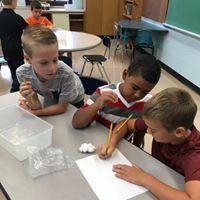
In grades K–2, students engage in what we call “Nano Challenges.” These experiences expose young learners to essential maker concepts such as stability, shape, cause-and-effect, and simple machines. They explore these concepts through play—building ramps, programming Blue Bots, experimenting with Quiver augmented reality models, and manipulating a wide range of materials to test their ideas. The language of making becomes something they understand not because it is taught explicitly, but because it is lived.
In grades 3–6, the challenges shift to “Mini and Macro Challenges.” These integrate more advanced engineering design, earth science concepts, and sustainability themes. Students craft models of watersheds to understand erosion, build structures designed to withstand extreme weather, design roller coasters to explore force and motion, and construct wind turbines to investigate energy transfer. They connect these projects to broader global issues by aligning them to the United Nations Sustainable Development Goals, helping them see how local actions link to worldwide challenges.
A Look Inside the Classroom: Sample Projects
3.2 Sample Projects by Grade Level
Grade | STEM Theme | Sample Projects & Concepts |
2 | Properties of Matter | Weather-resistant houses, flood barriers, bridge design |
3 | Earth Science | Watershed models, erosion simulations, marble roller coasters |
4 | Earth Changes & Energy | Weathering experiments using sugar cubes, wind turbine engineering |
K–6 | Cross-Grade Robotics | Blue Bots, Ozobots for pollination coding, Quiver for 3D modeling |
Innovation Nation | Sustainability | Water filtration prototypes aligned to SDG #6 |
Although projects vary from year to year, the intellectual trajectory remains consistent. Second graders might build flood barriers or bridges as they investigate the properties of matter. Third graders often explore landforms and water movement by constructing detailed watershed models that simulate runoff and erosion. Fourth graders examine energy and earth changes by designing systems that represent weathering or by engineering their own Siemens-inspired wind turbines. Across grades, students use tools such as Ozobots and Blue Bots to model real-world processes—from pollination to transportation—and apply computational thinking in accessible, age-appropriate ways.
In our Innovation Nation program, older elementary students design water filtration systems and tie their solutions to global concerns such as water scarcity and pollution. These experiences not only reinforce academic understanding but also elevate students’ sense of purpose.
The Impact on Students
Students consistently articulate how STEM helps them see themselves as creators and problem-solvers. One student reflected on this transformation: “STEM has taught me a lot. From making models of houses to making actual projects… We made a car out of recycled materials, and it actually worked. We also built a house that could survive major storms. We each had different jobs. I enjoyed this project a lot.”
That sense of enjoyment—and the pride of seeing one’s ideas become reality—is exactly what the program is designed to cultivate.
The elementary program also ignites passions that carry into secondary school. Over time, we have watched students who first coded with Blue Bots in first grade later produce broadcast news segments, design complex architectural models, or serve on the student-run tech help desk. The early foundation makes this progression feel natural.
Perhaps most importantly, the elementary STEM program has become a model of sustainability. As teachers across the building observed students’ enthusiasm, they began creating mini makerspaces in their classrooms to extend learning beyond the STEM lab. The program’s popularity among students and staff alike has helped embed STEM as a norm rather than a specialty.
This early spark prepares students for the deeper exploration that takes place in middle and high school.
4.0 Forging Pathways to the Future: Career Readiness in Middle and High School
By the time students reach middle school, their early experiences with tinkering, building, and problem-solving have grown into skills that can be applied with greater intentionality. Middle school STEM at C-A serves as the bridge between early curiosity and purposeful career exploration.
Students participate in courses such as Middle School Technology, where they engage in digital media production, coding, structural engineering, and technology literacy. They also collaborate on interdisciplinary projects such as Future Cities, which requires them to research infrastructure, design sustainable urban environments, and present their ideas to authentic audiences. These experiences help students understand how engineering, environmental science, design, and civic planning intersect.
At the high school level, we offer multiple pathways that allow students to pursue their areas of interest with depth and seriousness. The C.A.S.H. Program—a student-run technology help desk—empowers students to provide real tech support for their peers and teachers, developing skills in troubleshooting, customer service, communication, and leadership. Students interested in engineering and fabrication can enroll in Motorsport Technology and Advanced Fabrication, where they work with high-level equipment to design, weld, cut, and assemble mechanical systems, including karts, tools, and structural components.
Our environmental science programs immerse students in authentic research through beekeeping and river studies. Students maintain beehives, collect data on hive health, and analyze environmental conditions. River studies involve sampling, testing, and monitoring the Hudson River ecosystem, connecting science learning to local environmental stewardship.
Agriculture programs introduce students to plant science, soil systems, and agricultural engineering, blending traditional agricultural knowledge with modern science and technology.
These pathways demonstrate a consistent belief: learning should be relevant, applied, and aligned to the real world. Students see STEM not as abstract content but as a set of tools for making sense of their environment and shaping their futures.
5.0 Redefining Success: From National Recognition to Student Empowerment
Success in our district is measured not only through awards or test scores, though both reflect the strength of our programming. Rather, success is defined by the experiences and capabilities our students develop over time.
One form of success is the national recognition our district has earned. Being named an AASA Lighthouse District validated our whole-child, future-driven approach, while receiving Apple Distinguished School and District designations affirmed our commitment to innovative digital learning.
Another indicator of success is instructional excellence. The elementary STEM program, for example, emphasizes growth in confidence, collaboration, self-direction, and productive struggle. Teachers observe students persisting through challenges, communicating their ideas more clearly, and applying academic concepts in increasingly sophisticated ways. These outcomes align with the Next Generation Science Standards and emerging research on the importance of learner agency.
Perhaps the most powerful evidence of success comes directly from students. Their products—digital media, engineered systems, coding projects, architectural models, AI-generated artifacts—demonstrate deep understanding. When students explain what coding means with impressive clarity or document engineering processes with professional quality, they reveal the depth of their learning.
We also see success long after students leave our classrooms. It is common to hear from alumni who are now pursuing careers in engineering, environmental science, agricultural technology, computer science, and advanced manufacturing. As one teacher described, “It is rewarding seeing former students graduate and go into STEM fields. What better job could I have?”
This long-term impact shows that our STEM ecosystem does more than enrich students’ school experiences—it shapes their futures.
6.0 Lessons from the Lab and the Racetrack: Evolving Our Practice
Our growth has been shaped by a willingness to reflect, iterate, and adapt. Some of the most valuable lessons emerged from our earliest projects.
One important lesson is the power of trusting students. When we transitioned from assembling mini bike kits to designing and fabricating full go-karts, we learned that students rise to meet high expectations when equipped with supportive structures. Their creativity, craftsmanship, and determination exceeded anything we could have predicted.
Another lesson centers on sustainability. During the first years of elementary STEM, the teacher spent significant energy creating systems that could endure staff absences or schedule disruptions. The pandemic underscored the importance of these systems, proving that learning must be flexible enough to survive unexpected challenges.
We also learned the value of programmatic advocacy. Teachers embraced the need to communicate openly about materials, time, space, and technology requirements. This advocacy led to stronger administrative support, improved materials budgets, and wider staff buy-in.
Vertical alignment proved essential as well. As the elementary STEM teacher observed, students thrive when skills build from year to year rather than existing in isolation. This realization inspired greater collaboration among teachers across grade levels to ensure that foundational concepts introduced in elementary school prepare students for the complexity of middle and high school work.
Finally, we discovered the contagious nature of curiosity. As students shared their excitement, more teachers integrated making, coding, and engineering into their own classrooms. This organic adoption transformed the culture, embedding STEM as a shared value rather than a separate program.
These lessons continue guiding us as we plan the next decade of STEM innovation.
7.0 Our Vision for the Next Decade: A Thriving, Evolving STEM Ecosystem
As we look ahead, our district remains committed to expanding and strengthening our STEM ecosystem in strategic, purposeful ways. We plan to grow our network of partnerships, including collaborations with Knolls Outreach and additional community and industry organizations. These partnerships will provide students with new opportunities to engage in authentic, career-aligned learning.
We also intend to introduce a C.A.S.H. program at the elementary level so that student leadership in technology support begins earlier. This expansion will create continuity across the K–12 system, helping students develop confidence and digital problem-solving skills long before high school.
Artificial intelligence will continue to play an increasingly significant role in learning. Teachers and students are already using tools such as Magic School AI and OYO AI Communities to build customized AI modules that support revision, feedback, and exploration. We plan to expand these integrations thoughtfully and ethically, equipping students with the skills needed to navigate an AI-rich world.
Professional learning remains a priority, particularly as we continue strengthening instructional coaching aligned to the New York State Computer Science Standards. Teachers will receive ongoing support to design lessons that blend coding, computational thinking, digital citizenship, and interdisciplinary applications.
We also aim to expand competitive STEM opportunities by introducing programs such as SeaPerch, an underwater robotics competition that challenges students to engineer submersible vehicles for real-world missions. This addition will complement our existing robotics and engineering offerings, giving students new pathways to apply high-level design principles.
Ultimately, our vision is for Coxsackie-Athens to maintain a fully self-sustaining, ever-evolving K–12 STEM ecosystem where curiosity drives learning, student voice guides design, and every learner sees themselves as capable of shaping the future.
As Addison reminded us, STEM should feel fun, energizing, and full of possibility. That joy is the engine of innovation—and the reason we continue building environments where students can explore, create, and thrive.