
Walk into a classroom on a hard day, a student who won't make eye contact, a transition that's about to fall apart, a kid who's shut down and done talking and you'll see quickly why some of the most effective support doesn't start with words at all. Sometimes it starts with four paws and a wagging tail.
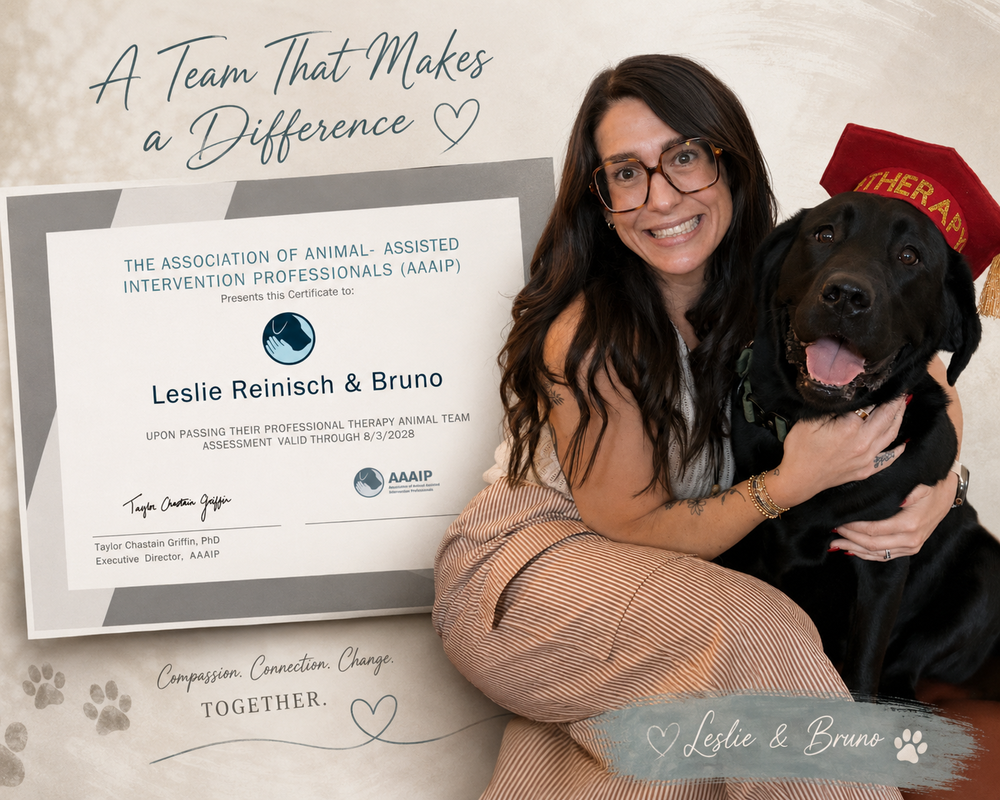
That's the idea behind Animal-Assisted Intervention (AAI), and it's why Coxsackie-Athens is proud to bring this program to our students. Following the Board of Education's approval of the district's new therapy dog policy, our district now has its first approved animal-assisted intervention team: Leslie Reinisch, School Psychologist and CSE Chairperson, and her certified partner dog, Bruno, working together with purpose.
More Than a Visit — A Partnership
It would be easy to picture this as "someone brings their dog to school." It's something different, and more deliberate than that. Animal-Assisted Intervention pairs a Certified Animal-Assisted Intervention Specialist (C-AAIS) with a professionally trained dog to function as a single team. Reinisch brings the clinical background understanding of student needs, intervention planning, and professional judgment about when and how to use this support. Bruno brings a calm, steady presence that helps lower the barriers standing between a struggling student and the adults trying to reach them.
Together, they create conditions that make learning, connection, and regulation more possible especially for students who find traditional approaches hard to access.
Why It Works
Every student is different, but the goal of AAI is consistent: meet kids where they are, and help them move toward where they need to be. In practice, that can look like:
Building trust with guarded students. Some students are hesitant to open up to adults, especially early in a relationship. A dog doesn't ask questions or make demands — which often makes it easier for a student to lower their guard.
Supporting regulation in the moment. When anxiety or stress is running high, a calm animal presence can help a student settle enough to re-engage, rather than escalate or shut down.
Motivating participation. Students who are reluctant to attend, transition, or complete tasks sometimes find the extra reason they need when a dog is part of the plan.
Making coping skills concrete. Breathing exercises, grounding strategies, and other coping tools can feel abstract to kids. Practicing them alongside a dog gives students something real and immediate to connect the skill to.
Softening hard moments. Difficult days, tough transitions, and moments of heightened need are part of the school experience. A steady, familiar presence can offer comfort exactly when it's needed most.
Strengthening belonging. Ultimately, the goal is bigger than any single interaction — it's helping students build a positive relationship with school itself.
Meet the Team
Leslie Reinisch brings a strong clinical foundation to this work. Her experience as a School Psychologist and CPSE/CSE Chairperson means she understands student needs across academic, social-emotional, behavioral, and special education settings, and she can match support appropriately based on the student, the situation, and the goals of the school team.
Bruno is friendly, easy-going, and remarkably steady, even in loud, chaotic, or overstimulating environments. That calm isn't accidental — it's the result of training and preparation that makes him reliable in real school settings, not just quiet ones. Students who might not respond to a worksheet or a conversation often respond to Bruno — and that response becomes the opening adults need to build trust, reinforce skills, and deepen engagement.
A New Kind of Support
"We're excited to support our students in new ways," said Dr. Dan Kalbfliesh, Superintendent of Coxsackie-Athens Central School District. "This isn't a traditional therapy dog visiting once a month to say hello — this is a certified clinical specialist and a trained dog working as an intervention team, built into the fabric of how we support kids every day. That's what makes this program different, and that's what makes it powerful."
This program isn't a replacement for the academic, social-emotional, and behavioral supports already in place across our district; it's a complement to them. It gives our team another tool, used thoughtfully and matched to the student, the situation, and the goals already set by school teams.
When learning feels hard to access, sometimes what a student needs first isn't a lesson — it's a reason to feel safe enough to try. That's what this partnership is here to offer.